Optimizing Adaptation of Smart Traffic Lights with Resource Constraints
An agent-based traffic simulation that picks which intersections to upgrade to smart traffic lights under a fixed city budget.
Abstract
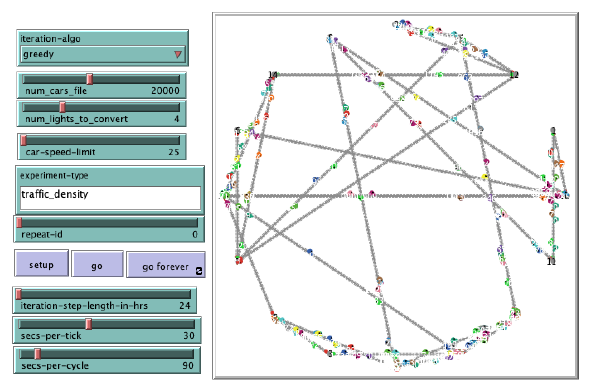
Large cities worldwide are facing many challenges, such as a growing population, which leads to an increase in traffic congestion. In many places, city road infrastructure does not cope well with growth in the number of vehicles leading to long waiting times on roads and decreasing fuel economy. Due to inflexibility to update city roads comfortably in most places, the adaptation of smart traffic intersections provides a promising approach to curb growing traffic and reduce wait times on road intersections. Still, faltering public budgets do not allow costly transport infrastructure expenditures, and deploying and maintaining sensors to enable smart intersections throughout a city is resource-intensive. In this paper, we explore the idea of efficiently deploying smart intersections within given budget constraints in a city. We propose a generic simulation-based framework that models city traffic based on historical patterns and utilizes agent-based modeling to select an optimal subset of road intersections to improve traffic conditions for a given city network. We validate our framework with state of the art urban mobility framework and demonstrate its utility with a simple road network. We further employ our framework to study the impact of variation in traffic characteristics and budget constraints on the efficiency of deploying smart lights.