Brick: Towards a Unified Metadata Schema For Buildings
A uniform metadata schema for building sensors, equipment, and relationships, used to represent 17,700 data points across six buildings.
Abstract
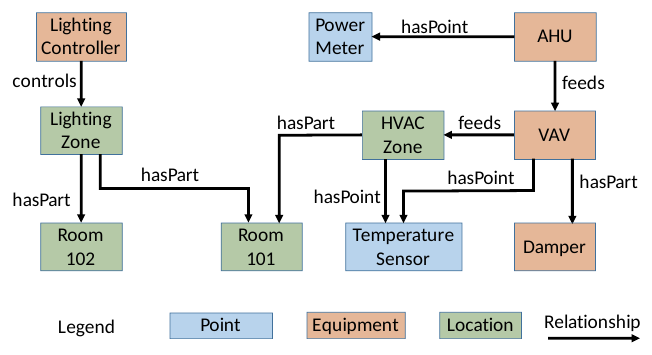
Commercial buildings have long since been a primary target for applications from a number of areas: from cyber-physical systems to building energy use to improved human interactions in built environments. While technological advances have been made in these areas, such solutions rarely experience widespread adoption due to the lack of a common descriptive schema which would reduce the now-prohibitive cost of porting these applications and systems to different buildings. Recent attempts have sought to address this issue through data standards and metadata schemes, but fail to capture the set of relationships and entities required by real applications. Building upon these works, this paper describes Brick, a uniform schema for representing metadata in buildings. Our schema defines a concrete ontology for sensors, subsystems and relationships among them, which enables portable applications. We demonstrate the completeness and effectiveness of Brick by using it to represent the entire vendor-specific sensor metadata of six diverse buildings across different campuses, comprising 17,700 data points, and running eight complex unmodified applications on these buildings.
Bibtex
@inproceedings{Balaji2016,
  doi = {10.1145/2993422.2993577},
  url = {https://doi.org/10.1145/2993422.2993577},
  year = {2016},
  publisher = {{ACM} Press},
  author = {Bharathan Balaji and Yuvraj Agarwal and Mario Berges and David Culler and Rajesh Gupta and Mikkel Baun Kj{\ae}rgaard and Mani Srivastava and Kamin Whitehouse and Arka Bhattacharya and Gabriel Fierro and Jingkun Gao and Joshua Gluck and Dezhi Hong and Aslak Johansen and Jason Koh and Joern Ploennigs},
  title = {Brick},
  booktitle = {Proceedings of the 3rd {ACM} International Conference on Systems for Energy-Efficient Built Environments - {BuildSys} {\textquotesingle}16}
}
Plain Text
Balaji, Bharathan & Agarwal, Yuvraj & Berges, Mario & Culler, David & Gupta, Rajesh & Kjærgaard, Mikkel & Srivastava, Mani & Whitehouse, Kamin & Bhattacharya, Arka & Fierro, Gabriel & Gao, Jingkun & Gluck, Joshua & Hong, Dezhi & Johansen, Aslak & Koh, Jason & Ploennigs, Joern. (2016). Brick: Towards a Unified Metadata Schema For Buildings. 41-50. 10.1145/2993422.2993577.