The Price to Site: Cost-Effective Incentives for Solar Deployment
A nationwide agent-based model of rooftop-solar adoption to design cost-effective incentives as the 30% federal tax credit ends.
Abstract
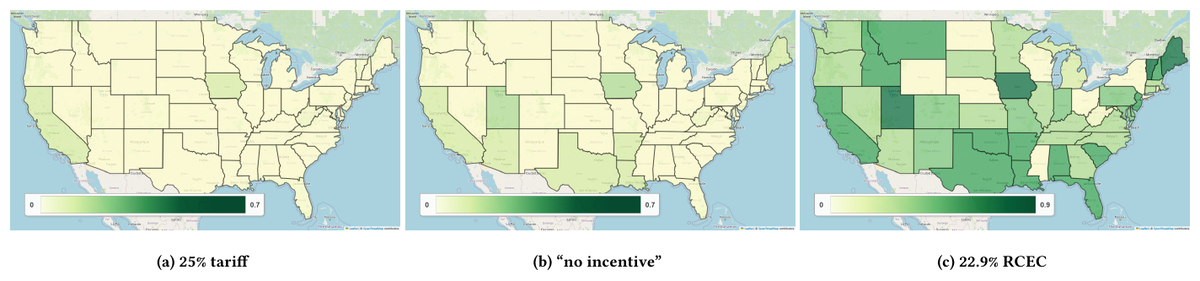
Historically, tax incentives have been the most important tool used by the United States federal government to influence the future of solar installations. In 2026, the current 30% tax credit for residential and rooftop solar will be rescinded, marking the largest change to this policy in over 20 years and naturally prompting questions about the effects it will have on adoption. Changes in solar adoption patterns have been recently shown to correlate with changes in progress on overarching societal goals such as carbon emissions reduction, clean energy capacity, and distributional equity. In this paper, we present a fine-grained agent-based model to simulate nationwide households and their reactions to a variety of different incentivization policies, including the scheduled rescission of the 30% tax credit. By simulating adoption patterns, we attempt to characterize possible trajectories for rooftop solar installations in the near future. Over the next five years, we find that continuing a 30% tax credit would increase carbon emissions reduction by 51.8%, new energy generation capacity by 38.7%, income equity by 13.8%, and racial equity by 11.0% compared to the baseline scenario where new rooftop solar installations are not eligible for any tax incentives. Furthermore, we explore the trade-off of these, and other, incentive possibilities under our studied metrics of carbon, energy, and equity, finding that incentives offsetting more than 22.9% of the upfront installation costs exhibit diminishing returns in all metrics. We estimate that this undiminished 22.9% incentive would achieve a 25% reduction in costs relative to the former 30% tax credit over a five-year period, while preserving more than 90% of the realized benefits across all metrics, making it a good candidate for a cost-efficient alternative policy.