arXiv 2021
The Design of the User Interfaces for Privacy Enhancements for Android
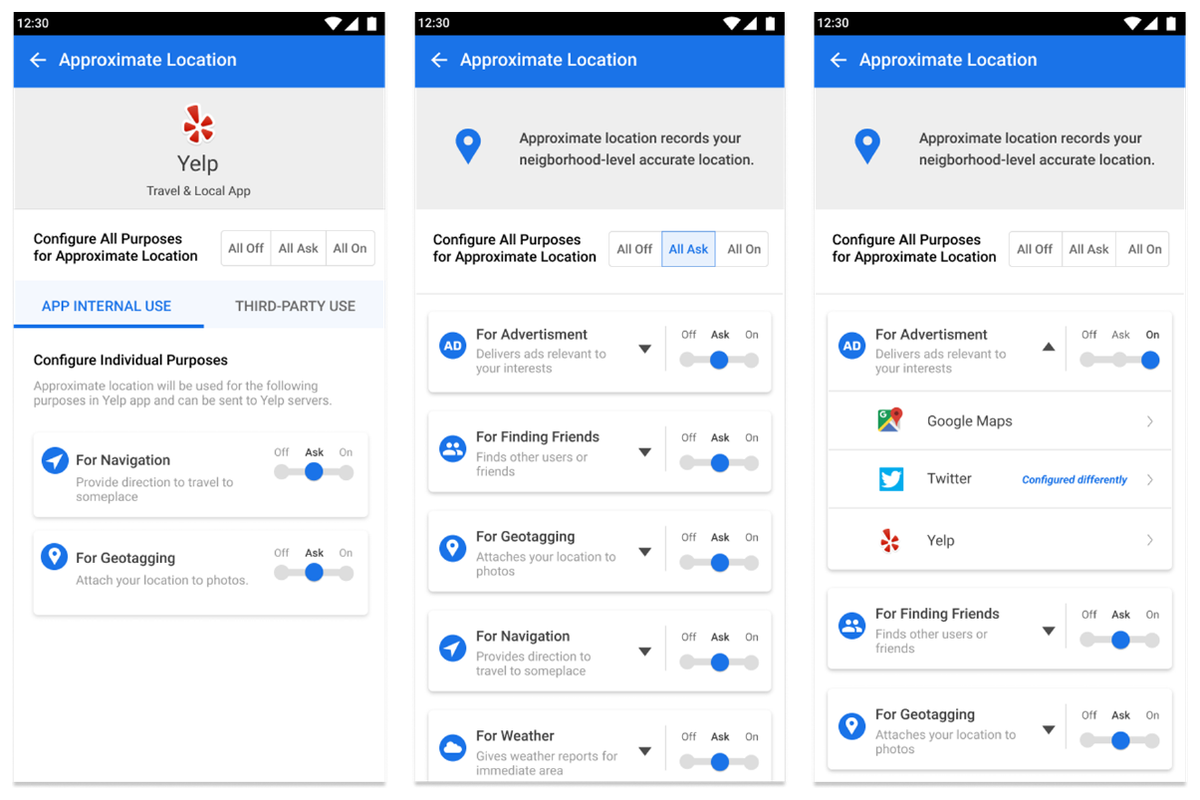
User interface designs for Android privacy settings built on developer-declared purposes, split between first-party and third-party data use.
Jason I. Hong, Yuvraj Agarwal, Matt Fredrikson, Mike Czapik, Shawn Hanna, Swarup Sahoo, Judy Chun, Won-Woo Chung, Aniruddh Iyer, Ally Liu, Shen Lu, Rituparna Roychoudhury, Qian Wang, Shan Wang, Siqi Wang, Vida Zhang, Jessica Zhao, Yuan Jiang, Haojian Jin, Sam Kim, Evelyn Kuo, Tianshi Li, Jinping Liu, Yile Liu, Robert Zhang
arXiv 2021 -- arXiv.org, CS, Technical Report: arXiv:2104.12032. April 2021
Abstract
We present the design and design rationale for the user interfaces for Privacy Enhancements for Android (PE for Android). These UIs are built around two core ideas, namely that developers should explicitly declare the purpose of why sensitive data is being used, and these permission-purpose pairs should be split by first party and third party uses. We also present a taxonomy of purposes and ways of how these ideas can be deployed in the existing Android ecosystem.